Translate

The cruising adventures of Sid and Manuela

Sunday, May 08, 2011

Cholon, a hideaway in Colombia

Sorry for not having updated our Blog in a while, we’ve been caught in a bit of a mess dealing with our buddy boat and are still in the midst of it so when this is all over with I will get you up on speed
Here is just a brief update:

Cartagena is so dusty, the boat sooooooooo filthy and forget about wishing or hoping for some rain, the rainy season is not due until at least June/July. How do you clean the boat in this situation? Well here is how it’s done:


Sid the genius did it again!

We decided to go back to beautiful Cholon it is so much calmer and cleaner there besides we wanted to catch up some more with Carmen and Roberto.  Sid is helping Roberto and Ken to fix up Manatee a 68 foot Shrimping Boat to get shipshape. They are working on it 12/7 and are having a wonderful time and at the end of the day they look like they worked a coalmine and smell like they sprayed themselves with Eau de Engine Oil.


This place is a true Paradise, the sunrises magical the days quiet, beautiful sunsets and cool nights with magnificent view of the stars.
The vulgar birds are still keeping us in stitches and I just noticed that the video did not completely upload so here it is again:


Sorry if this is a short and not very exciting note I promise the next report will be back to our normal life.
Hugs and kisses everybody

The Boatbumms still in and on Paradise

Saturday, March 26, 2011

Cholon and friends visiting

After a couple of weeks of socializing, shopping, some boat chores, annoying sulfur and smoke smells in the early mornings causing sinus problems, being waked by what seemed hundreds of boats all day long, a lot of barnacles growing very fast on the bottom of the boat, we decided it was time to head into a cleaner and more quite environment. Sid was shocked to see that the boat from the waterline all the way to the bottom of the keel was 99% covered with barnacles when he cleaned the propeller. That kept us busy for a couple of hours in the clean anchorage of Cholon. (Don’t get me wrong as bad as the anchorage in Cartagena sounds, it has a breath taking view and it is worth stopping here to see charming Cartagena Vieja).

The night before we left we had Keith and Rob over for dinner. Couldn’t have been a better evening to invite Keith as during dinner he told us know that this was his Birthday. It sure made Keith’s day not having to celebrate it alone and ours that we had chosen the perfect day. Happy Birthday Keith! 

Amazing the wind had been blowing out of the NE ever since we arrived in Colombia but of course the day we’re trying to sail west the wind came out of there. We motored though the channel of Boca Chica which reminded us of the ICW except for all the tourist boats speeding on either side leaving huge wakes behind. The entrance to Boca Chica is very beautiful as there is a well preserved fort on either side. 

Heading out the Boca the water was calm with only a one foot long swell out of the North. We pulled the sails out and since the wind was right on the nose we had to sail 90 degrees off our course. For about 15 minutes we sailed at 3 knots then we gradually slowed down as the wind got lighter. When the knot meter read 1.8 knots we had enough and pulled the jib in and motor sailed the 9 miles to the first way point. After that we had four more to follow for which the last one was very confusing as it was behind the island and we do not sail well across land. Some adrenaline was flowing while trying to figure out where to next. There seemed to be a little channel between the two islands, one had a long reef extending the other a shallow beach. As we watched a pleasure boat motoring through the cut we followed him very, very slowly with Sid on the bow and Manuela steering with a sharp eye on the depth sounder. Can you imagine driving your 6 foot draft boat through a narrow channel  and only 10 feet next to you are people standing in waste deep water waving to you, yikes. 

We managed to get into the Bay of Cholon with no problem, lots of friendly waves from swimmers and never saw less than 10 feet of water. The bay is huge and, very protected weather wise but unfortunately not from scum bags. The night before we arrived two dinghy engines where stolen off two cruising boats. Even though both dinghies were pulled out of the water during the night the thieves managed to steel the motors as they were not locked to the dinghy.  Lock it or loose it!

          The bay is beautiful with several little islands just big enough for some big shot to build a weekend retreat on it. The anchorage has good holding and the water is a lot cleaner than in Cartagena although not clear either. First thing we did was clean the bottom of the boat, yikes that was some work, we were sore for a couple of days from the underwater acrobatics.
We had the best reunion with Carmen and Roberto, formerly “Fresh  Air”, last time we saw them was 10 years ago in Cartagena. They live up on top of the hill in a huge house, had a bit of  confusion when they built it, between feet and meters so they ended up with a house triple the size than planned. The house “Crows Nest” is nestled on top of the hill surrounded by lush vegetation with a breathtaking 320 degree ocean view, wow. In the bay sits an old big shrimping boat “Manatee” owned by Roberto and Carmen and every Wednesday and Saturday they have a Happy Hour on board. Some times it’s a potluck and some times Carmen cooks up Hot Dogs. When we participated we had a scrumptious potluck and everybody that played an instrument brought it along. We had one guitar and 3 harmonica players and we played way into the night.


Daily Crows Nest and Paradise went for an early morning walk along the bay, Paradise ending up with blisters on their feet, had fresh brewed coffee afterwards overlooking this beautiful bay.


Roberto and Carmen


Manatee

The nights were so quite you could hear a mouse fart, but just before the sun puts her blinking eye over the horizon peacocks started screaming in unison, being followed by another species of bird which we have not found out yet what it is. This bird call is so pretty it sounds like a flute. Then there is the Guacharaca a bird about 53 - 58 cm, dark brown above and pale below dull plumage and similar in appearance to a turkey with smaller head, long strong legs and a long broad tail. This bird makes the loudest noise of all the birds and like the wave at a foot ball game from one side of the bay to the other. We asked for the English name of the bird, nobody seemed to know and it didn’t Sid take long to figure out the name himself as all you hear when they squawk is: “whatthefuckwhatthefuckwhatthefuck”.  I read up on it, it’s a Rufous- vented Chacalaca, Ortalis rificauda a member of an ancient group of birds of the Cracidae family. It inhabits northeast Colombia and Venezuela. It is also known as Cocrico and can also be found in the Grenadines, Bequia and Union Island. The male’s call is a loud and low ka-ka-rooki-rooki-ka answered by the female’s high-pitched watch-a-lak. I don’t’ blame them for yelling back what we think is what-the-f….
I tried to capture the sound on a video but only managed to get the peacock and the flute bird but if you listen very carefully you will hear them. 


We had a wonderful time but also some problems with the alternator, it did not charge our batteries which is a mayor problem. Also the solar panel regulator quit working so did the wash down pump so back to town. Besides we were expecting visitors and didn’t want to chance getting stuck in Cholon. The weather was another worry as it had been howling 25 knots for a solid 3 days, we had a break in the weather and we took it with a gentle 10 knots on the nose.

          We were all excited to have guests and what a perfect timing, we just got out of the Taxi in front of the Charleston Hotel in Old Town Cartagena when Dave Baker our friend got out of the Taxi right behind us. His friend jerry Maize joined him and we had nothing but a good time. Don’t know who wore whom out, I’ll just let the photos talk:

We explored the Cartagena Vieja (Old Town):


Walked the famous old wall “Murales” around the city


Climbed the San Felipe Fort with Gustavo our tour guide:


Meet Gustavo (click on arrow to watch):

Talked to Mom (ask Dave who’s Mom):

Ate at the best restaurants in town:

Roof Restaurant at Charleston Hotel

Wonderful Lunch at Club de Pesca


Assorted tropical fruits on Paradise
Got hooked on Mojitos and Zacapa Rum:


Toured the Bay in a speed boat and explored the Boca Chica Fort”


Where Romancing the Stone with Kathleen Turner and Michael Douglas was filmed:


Of course we also rested in the cockpit of Paradise catching up on good old times and savoring the moment our friends were with us. Dave found a few things he thinks we should change on the boat like this:
From:

To:

So here is a big cheers from all of us!
Dave is a member of our PMYC Yacht Club

Wednesday, March 02, 2011

Sail to Cartagena

Boca Grande Cartagena
When the alarm sounded at midnight the wind was howling again.  Not good! We were going to leave the marina but with gusts up to 28 knots and healing in the slip we decided to wait and see. It was frustrating as this was not predicted in the weather forecast. One our later the wind calmed down a bit an occasional 28 knot gust. At 2 AM it slowed down long enough to sneak out of the slip and marina, we pulled the sail up and headed towards Baranquilla. We came to the conclusion that the winds in Santa Marta are mainly a local condition as we now had a 10 to 15 knots the sea was relatively calm it was a good day to be sailing. After the sun blinked over the Sierra Nevada we actually could see the snow capped mountain peaks, well the snow we did not really see but we saw the silhouette of the majestic Sierra Nevada, it was very pretty. The view was only for a bout 5 minutes before it got lost in the haze. Our first leg was 20 miles to the point where the Magdalena River meets the sea. We had a feeling that towards that corner we would have some higher seas and eventual more wind as well and sure enough about 10 miles from the point the winds started escalating and the waves started to get higher and much, much closer together and one wave managed to broach us filling the cockpit with about 50 gallons of water. It wasn’t really that rough, the waves were just too darn close together and pretty much on the beam. Approaching the Magdalena River is quite intimidating, on the far horizon you see some brown stuff almost looks like some sand piles, very unnerving but than I remember from other cruisers description that it is not patches of sandy beaches but where the cappuccino colored dirty water of the river meets the ocean. It’s amazing the change from blue to brown water and the waves at that point are very high, steep and inconsistent the highest, it gives you the willies and white knuckles holding the wheel. We knew to stay off shore for at least 2 miles and seeing this mess I tried to follow the outflow as far as I could before we finally got into the mucky wild water about 3 miles off shore. As soon as we hit it we changed course and had the unsettled sea coming from behind us which was no problem. We now had a 2.5 knot current pushing us though the muddy water we did speeds up to 8.9 knots, nice. For about 2 miles we had this ugly mess then it gradually became calmer and after about 5 miles the water slowly changed color but stayed murky for the rest of the trip. Even though it was now pretty calm one wave still managed to slap us in the butt and dumped another 20 gallon of water into the cockpit. Sid got pretty good in shoveling the water over board, I think the shoveling sand in Santa Marta helped! About 5 miles out from Punta Hermosa the wind started to pick up as it does every afternoon and with it we sailed into Puerto Velero (Punta Hermosa) with 25 knots of wind. After a 58 mile fast trip we dropped the hook in a very calm setting. This is a big bay with plenty of room for hundreds of boats but amazingly we were the only cruising boat anchored. Wind Shear didn’t leave with us as they had to wait for fuel delivery at 5.30 in the morning. They didn’t leave Santa Marta until 10.30 and had a fairly rough ride with 25 knots of wind. Just before the muddy river they caught a fish trap and fouled the prop so they had to sail. Before they turned into Punta Hermosa or what the locals call Puerto Velero, they were able to run the engine again.
I didn’t take long for the Coastguard to tie up to us. Again I have to say we were treated with the utmost respect, they greeted us and told us that we were in a safe place to anchor and could stay for days. They wanted to know if we had a phone and gave us their phone number to call them if we had any problem and asked us that when we leave to contact them so that they could contact Cartagena to let the Coastguard there know that we were underway and make sure we were safe as this stretch of coast is questionable according to them. Before we left Santa Marta I questioned the Guardia in the Marina about this anchorage, they said it was OK but gave me a phone number of a guy owning a restaurant to call in case of emergency. We feel that we are in good hands here!
Poor Sid wasn’t feeling good the entire trip, sore muscles, headachy and later on that day he came down with a high fever. Knowing of Steve’s dengue he caught in Santa Marta we feared the worst. The following morning he had a slight temperature and it went away. But we decided to stay put and let him rest. Later as the fever returned with a vengeance we decided to boogy to Cartagena the following day to be close to any medical facility if needed.
The wind had subsided, we could have used at least 5 more knots of it to be able to sail, should have left the previous day, oh well. The last two hours of the trip we were finally able to turn the engine off and quietly sail slowly along the Colombian coast, while we wanted for Wind Shear to catch up with us. It was exciting to finally see all the high rise buildings of Boca Grande on the horizon and our anticipation rose. Approaching the old town brought nothing but good memories back and heading into Boca Grande we noticed there were now two instead of just one buoy. Sailing between the buys into Boca Grande we realized that we just had circumnavigated the Caribbean, wow it took us 10 years, could have gone around the world a couple of times. Hey after all we are the Turtle Express!!!
A huge dark cloud was hovering over the entrance and it looked like we were going to get some rain, yeah, rain we needed it. But of course the cloud was just teasing us it released the rain somewhere away from us.
Wind Shear followed us into the harbor and we found Club Nautico exactly where we left it plus a whole bunch of boats in the anchorage. Last time we arrived there where only 6 boats anchored including us. Not just are there many more boats in the anchorages but also many, many more high-rise buildings wow this place has blossomed. This anchorage has nothing but a thick mud bottom which is hard to get hooked, first try was a miss so we moved to a different area and before pulling back on the anchor let is sit for a while. We’re settled in and are just excited to be back in beautiful Cartagena.
Club Nautico
Our first sunset
Cartagena Vieja

Sid still wasn’t feeling better it was coming and going, not just that I came up with the same thing and Debi started as well. We did go a shore to Club Nautico for paper work and surprised Keith on Tortuga. Last we’d seen him was a couple of years ago in Trinidad and before that 10 years ago in Cartagena and it was a happy reunion.
Club Nautico Marina was a crappy marina 10 years ago but ohmygosh is pitiful now, the docks are falling apart and where the once so much fun restaurant was it’s just a pile of rubble with a tarp for a roof and a huge mess. The showers are horrible, the bathroom portapotties, man what a dump. We pay 20 bucks a week to be able to tie the dinghy to the dock and go ashore but it comes with unlimited use of water and shower. Imagine, this marina has hours for water usage from 08:00 – 12:00, 14:00 – 19:00, so no showers after 7 o’clock! WI-FI is horrible so for now we have to go to the Internet Café.
Anyway, we’re feeling a lot better and are enjoying discovering Cartagena again and will be in this area for a while
Getting spoiled with 2 foot long yummy bacon!

Sunday, February 13, 2011

Minca

Minca is a small town of about 500 hundred people 660 meters (about 2000 feet) above sea level, nestled in the foothills of the Sierra Nevada and hidden in lush vegetation. Guides say the 14 mile winding road is traveled in 25 minutes.  I guess that was when the road still was free of potholes; it took us an hour on a very bumpy road, a beautiful drive though. The Sierra Nevada, in the shape of a pyramid, rises from the sunny coasts of the Caribbean tropics to the chilly, snow-capped peaks that reach a height of 17,000 (5775 m) feet above sea level, which makes it the highest tropical mountain in the world. Within just 30 miles/fifty kilometers the northern slopes descend from the snow capped peaks to the turquoise waters, tropical jungle shores and coral reefs of the Caribbean ocean.
Here you find trees of up to 40 meter (130 feet) heights. The Fauna supposedly they say is full of bears, deer and smaller species like armadillos, hedgehogs, ocelots and monkeys. Didn’t see any but we did hear the roar of howler monkeys. Thousands of birds, insects and butterflies are at home in this tropical forest, we saw many colorful hummingbirds. Minca is an ecological paradise with uncountable rivers, waterfalls and immense green vegetation which hides the archaeological remains of its ancestors the Tayrona Indians. Today in the highlands you can still find indigenous people belonging to Kággaba (Kogi), Ijka (Arhuaco), Wiwa (Arzario) and Kankuamo tribes, direct descendants of the Tayrona Indians keeping up with all the traditions.

We stayed at a cute Finka (Ranch) “Sierra Sound” which is located right next to a river with a stairway down to the river bed for bathing, a very, very beautiful place. 

You can stay at least a week here and hike each day a different path and find a different river or waterfall. We decided to visit the Arimaka Fall an hour hike up the mountain (years ago it was used by the Indians for religious ceremonies). On the way up the hill we ran into two local women chatting along the path, one was on her way home with her son and his donkey and motioned to follow her after I asked if this was the right way to the fall. She even offered us to ride the donkey which we declined. It was a fun walk up the hill and finally she pointed us into the direction of the waterfall while she headed another 25 minutes up the mountain to her home. 


It was about another 10 minutes before we arrived at the entrance to the waterfall. A friendly farmer chopping down some weeds greeted us and stopped what his was doing and nodded for us to go ahead that he will catch up with us at the waterfalls as this was his coffee plantation. We followed the narrow path and found the waterfall or falls in a hidden valley surrounded with lush vegetation. We climbed the many stairs down and were in awe as we finally stood under the waterfall. Since it was almost noon I brought a bottle of wine and snacks out and we sat there enjoying it. There came Juaquin the plantation owner down the steep steps balancing a tray in his hand with 4 cups of his freshly brewed coffee, wow what a treat. I offered him some wine and cheese we still had and Andy gave his 4 year old son a breakfast bar he really enjoyed. 

 
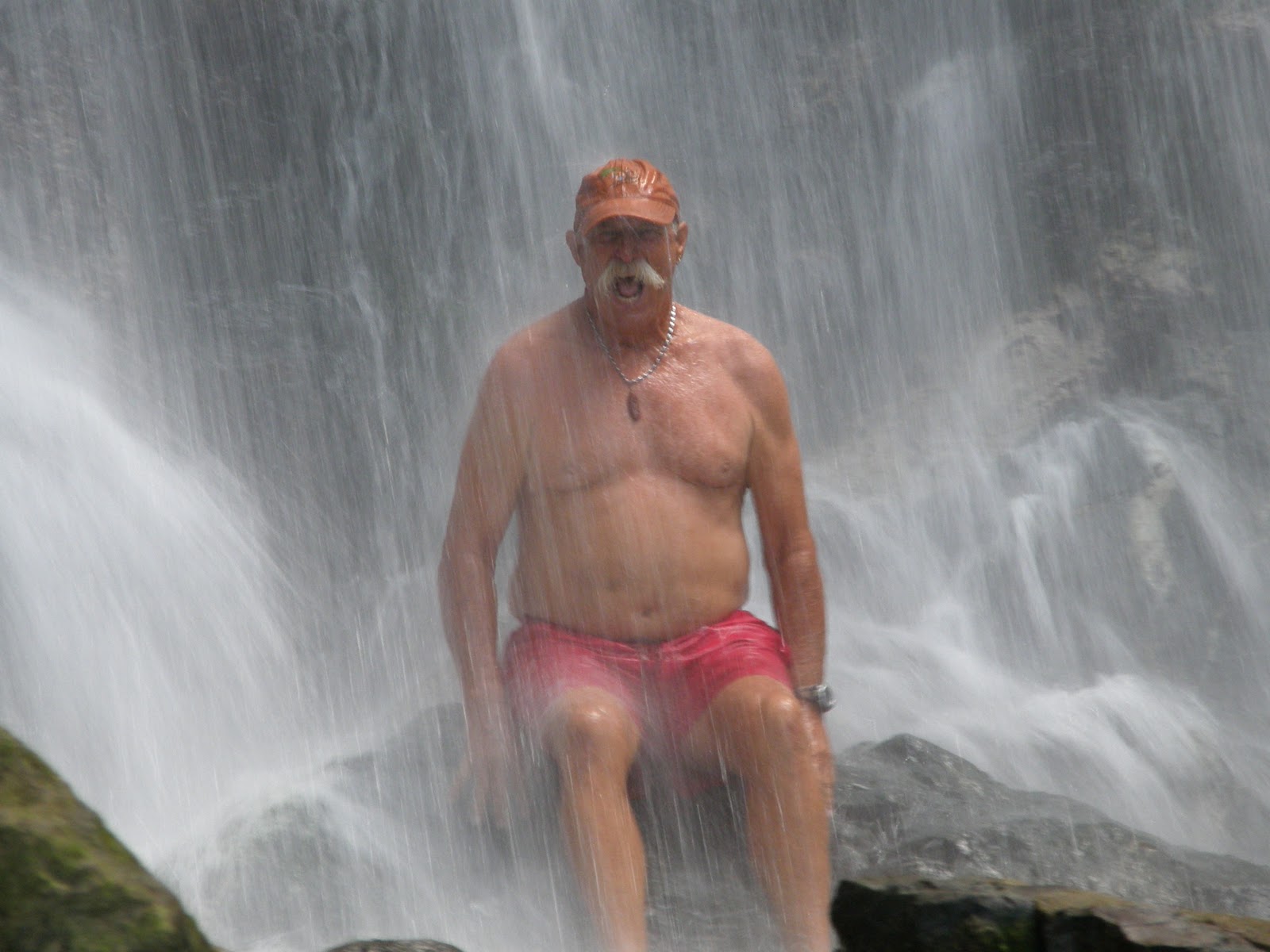
Juaquin invited us to go swim in the waterfall and told us that the better bathing is in the fall above the Arimaka. Sid and Susan braved it into the water, brrrr it was cold. 
BRRRRR is it cold!

Where is it?!! OH NO It's gone and I forgot to tie a string to it!
 On the upper fall “Marinka” I dared going into the water as well but oh boy was it cold but it was fun sitting under the water fall with water pounding on your head and shoulder but not for too long. After the refreshing shower we headed back to a thatched roof overhanging the hill with view of both waterfalls where Juaquin served us ice cold beer. 


We had all kinds of questions for him and his coffee plantation and so he invited us to his Finka. He showed us step by step all the processes of coffee making , all a lot of manual labor, including roasting the coffee, which each one of us was taking part, then he took a hand cranked grinder out, ground the coffee we just had roasted and made us some more coffee, wow what a wonderful flavor especially sweetened by panela (raw cane sugar). 
 
Finka Esperanza
Drying coffee beans

Juaquin roasting coffee

Charcoal stove

A real Redneck
This area is known for its wonderful coffee and has supposedly the best coffee world wide. I think this is also the only place where they roast coffee over charcoal. 
On any hike you will be able to find a coffee plantation here, each with different methods. I always thought that coffee grows on bushes not on trees, here they are all wild old trees and one had to climb the tree on steep hills to harvest the beans.
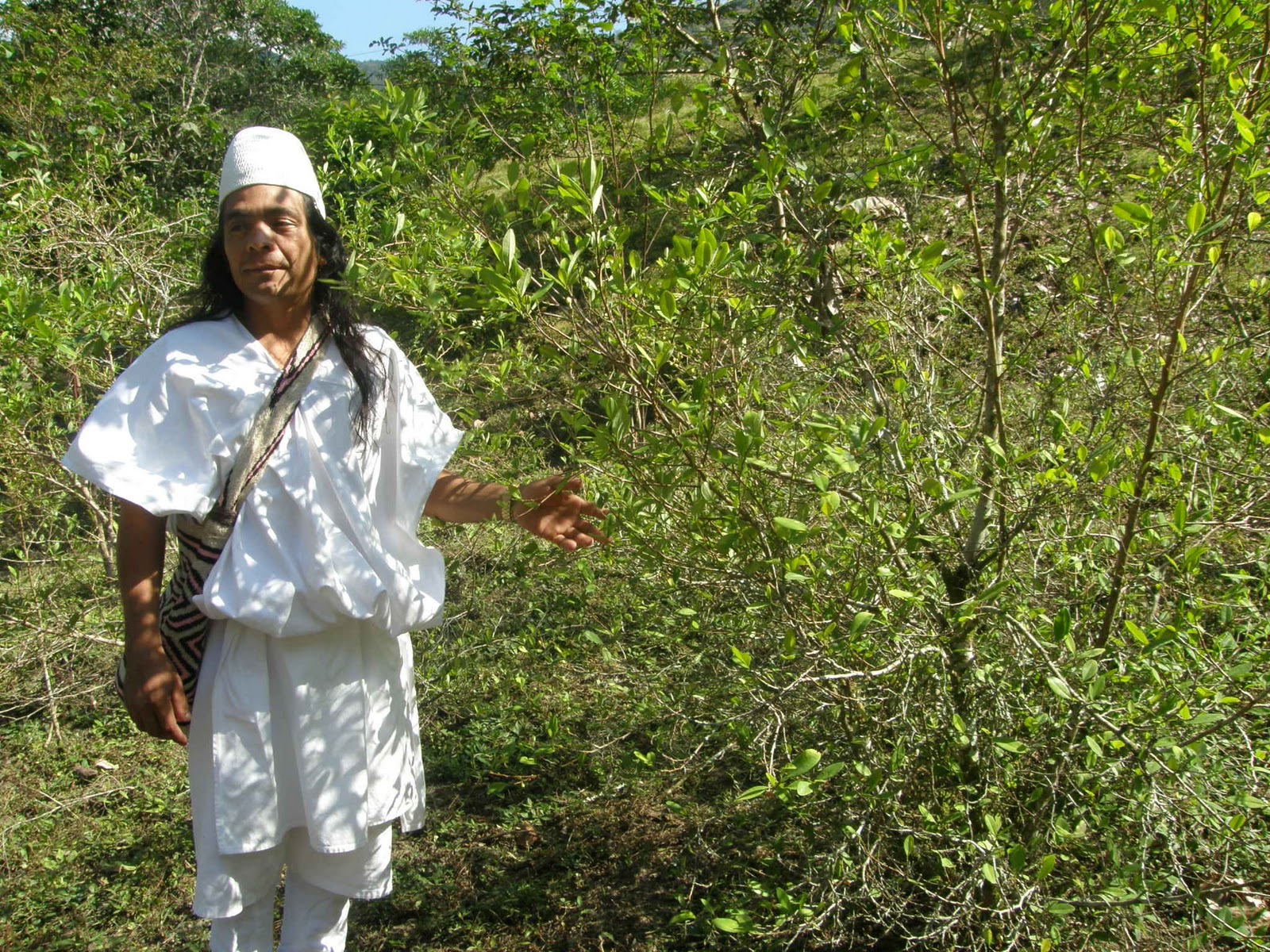
Rob was mentioning to us that he wanted to find some coca leaves so I asked the guy if they grow it in this are. Juaqin then started to tell us about coca and the Indians and invited us on a walk to visit Samuel one of the Arhuaco Indians who lives in the rain forest not far from him. It was a good 30 minutes walk when we arrived at his Finka. Joaquin told us also that the Mamas the spiritual leaders of the Kogi are getting together here in a few days for rituals. Koqui/Kogi Mamas are chosen from birth and spend the first nine years of childhood in a cave in total darkness learning the ancient secrets of the spiritual world or Aluna. They are the priests and judges who control Kogi society.  Their culture it’s fascinating Samuel was quite excited to meet us and showed off his Indian outfit that he put on especially for us to see and allowed us to take pictures for a donation of course. 
He is really proud of his ancestry and we felt pretty honored to be able to visit him and get such an insight. He brought us over to a coca bush and explained what they do with it. He took off his Lime container which is a small slightly pear-shaped gourd and perforated along the top. While all lime gourds consist of the same raw material, the wood of the stick which is inserted into it and is chosen by each owner for his own personality and identification. Samuel then explained that while slowly chewing some twenty or thirty toasted leaves, the man will wet the lower and slightly pointed end of the stick with saliva and will insert it into the gourd and he rotated  it. Withdrawing the stick again he will put the adhering lime into his mouth. Immediately he will rub the stick around the top of the gourd in a circular motion. Eventually, this daily repeated action of rubbing the stick on the gourd surface begins to form a thin layered crust of yellowish-white lime that covers the upper part of the container.
He gave us each a leaf  to chew on. Of course our anticipation was enormous to find out what will happen as we had no idea what to expect……………… Absolutely nothing!!! 

I think in general we are so miss informed about coca chewing. The coca plant was domesticated in Peru 7000 years ago and was traditionally used for initiations of marriages and to strengthen kinship and mainly medicinal purposes. It is also a common-practice for the Kogi Indians in the Andes, who, after puberty under go an initiation in which they are given coca leaves in small gourds. Within it, coca leaves are mixed with an alkali “Lime” produced from crushing seashells. When combined with saliva the alkaline will unleash the powers of the coca leaves which combats hunger, high altitude sickness and fatigue.
A Peruvian Study sh0ws that coca can help with asthma and depression or can be used as substitute for coffee to increase alertness (although coca does not have any caffeine). Further the study revealed an aid to metabolism of carbohydrates, combat diarrhea, increase sexual powers and also relieves muscle aches and inflammation. (Wow, I guess we came to the right place, I might be able to shed some weight!) They also make tea from coca leaves. A tea bag containing 1 gram of coca-leaf contains roughly 0.8 mg of Calcium, 3. 84 mg of Phosphorous, 1.26 mg of Magnesium and 30 mg of Potassium, as well as small percentage of Iron, including alkaloids, fiber, ash and vitamin A, B, C and E. Although the coca-leaf is grown in large amounts for cocaine production, it is also cultivated for tea-export from Peru. (I need to find me some of that).
After Samuel’s gourd demonstration we follow him into the ceremonial clay hut which took him 8 years to build; the same hut the ceremony took place a couple of days after our visit, wow. During the ceremony the Kogi produce Lime by burning sea shells on a small pyre carefully constructed with chosen splints. The fine white powder is then sifted into a ritual gourd which is carried by all men. In a special double-handed pottery vessel they then toast the coca leaves inside the temple (clay hut).  

 Small plantations of coca shrubs are found near all Kogi settlements, Coca shrubs are planted and tended by the men but the leaves are gathered by women. It is a part of the Kogi way of life, deeply involved with their traditions, religion, work and medicine
The tribe known as 'Los Kogui' are today's custodians of the Tayrona culture. They have a population of approximately 12,000 people. The Kogi plant crops and live off the land. They prefer not to mix with outsiders. Few Colombians, or those from the outside worlds, are allowed to enter their mountains. They marry in their culture. The Kogi constantly move about from place to place, between their different abodes spread among the different levels of the Sierra Nevada mountain range. This is looked upon as taking care of their nutritional needs without abusing the environment.
In 1990 the Kogi noticed a change in their environment and decided they must speak out to the rest of the world. The snows had stopped falling and the rivers were not full, so if their mountain was ill then the whole world was in trouble. The Mamas sent one of the Kogi who spoke Spanish to contact a British film maker who was in Colombia at that time. They asked BBC to make a film to tell the Younger Brother about their concern. It was called 'The Elder Brother's Warning 'or' The Message from the Heart of the World'. Alan Ereira, the producer, has also written a book about the Kogi called The Heart of the World. The film had a major impact on the Colombian Government and also on the grave robbers and things changed. The grave robbers felt that they should stop because they felt bad about disturbing their ancestors. There are now two Kogi members in parliament. To read more about the Kogi go to: http://www.crystalinks.com/kogi.html

On our hike back to Sierra Sound we relived the whole incredible day again, we all were just taken by what we all learned this day. We were so tired from all the walking we sank into the patio chairs and didn’t get out of them for hours. Partly because our legs were sore and the beer just tasted too good. All the fresh air gave us a good appetite and since they only had one order of the four cheese ravioli left we decided to share that for an appetizer. Ohmygosh was it good, not just were they home made and cooked to perfection but it was smothered in the creamiest sauce with flavor of cheeses and caramelized onions.


After a well deserved hot shower we all enjoyed a wonderful dinner overlooking the river with the acoustics of the water rushing over the river bed rocks. We retreated back into the sun chairs and enjoyed an after dinner drink. What a relaxing place!
Sid and I were up early on the terrace the following morning enjoying many cups of the wonderful local grown and brewed coffee and just enjoying this beautiful scenery. After a hardy breakfast we ventured off to the Pozo Azul Waterfall, an hour hike. Since I had some bites on my legs from the previous day we all sprayed extra Deep Wood Off on us. Arriving at the beautiful waterfall I noticed right away more of these red blood spots on my legs and sprayed even more juice on us. That should do. (When we arrived at Sierra Sound we met an English lady just leaving who’s legs were bitten up and told us that she got the bites at the waterfall and that the bug spray did not work. I thought to myself that she must have one without deet, well I was wrong, these little teeth with wings critters don’t care about deet).
We waded in the water and oh man was it cold, we were just in ankle deep water that was so cold that we got an ice-cream headache in our ankles, no swimming here that’s for sure. Those little wings with teeth called sancudos or jejenes (blackflies) you don’t even feel them when they bite. My legs were covered with red dots. Susan had a few bites but they left the guys alone. Hmmm I think they don’t like hairy legs, maybe we ladies need to stop shaving our legs?!!! The bites didn’t itch, well not immediately but 24 hours later oh man did they itch.


We hiked a bit further up the mountain but realized that it was time to head back we had one more waterfall on the agenda before heading back to Santa Marta.
Las Piedras, which means, “rocks “,are just about a 5 minute walk from the Sierra Sound Finka. Las Piedras are two rivers coming together forming one, with the water passing quite rapidly over the rock formations. The unique thing about it is the temperature of the water in each of these rivers. One is very cold and the other is quite warm. It is a real beautiful area people visiting like to relax in the water, letting the water massage the body. This time of the year it’s a bit too chilly but we sat in it anyway enjoyed the water rushing by. 

After another beautiful day in Minca it was time to say goodbye and head down the mountain again to Santa Marta. This was truly a wonderful experience we will treasure for years to come and who knows we may even return once more before we leave Santa Marta. Minca is a MUST visit. The ride back was fun too as we all had a rum and coke in our hands hanging out side the window so that we would not spill them with all the bumps. I didn’t help that the suspension of out taxi was shot. Sid in the front seat whenever he saw and opportunity to drink he yelled: “Drink! NOW!


Thanks to Sandial’s satellite TV we were all able to sit on the Dock and watch Super Bowl. It was a fun party with a wonderful spread of food.

Mariah and Cruiser

 The winds have returned and for many more days we endured getting sand blasted. For a couple of nights we had a steady 30 to 35 knots of wind and gust up to 50.
 Orestes on Milacura, we had met in Bonaire, sailed in from Cartagena. He had a miserable trip, lost his mainsail and one of the trampolines was trashed on his catamaran by the heavy seas. He was on his way to the Dominican Republic but decided to leave Milacura behind until the weather calms down some time in April. We had him and his crew Tito over for dinner and had a great time catching up. Orestes is the reason us cruisers found out that there is a marina in Santa Marta, thank you Orestes!
The same day an English single hander limped into the marina. He was on his way from Curacao to Jamaica when he was tossed around so much that one of the high waves smashed him so violently that the house between the pontoons on his small cat had a whole smashed into it. Of course every time he smashed down a wave again more water came in. The poor guy didn’t think he was going to make it and is just so thankful to be here. 

We’re definitely are not going to stick our noses into this kind of weather but are looking for a window to sail further south to Cartagena in the next couple of days or three or four. Monday might just be the day.


We finally managed to get Tim and Elena over for dinner. These two have just been wonderful to us and helpful in any way. Tim and Elena thank you so much for everything. (If you stop in Santa Marta don't forget to look them up and enjoy a delicious breakfast at their Cafe).